Basics
It's a fair question. Here's an honest answer.
When people hear "prediction markets," the first thing that comes to mind is often gambling. You're putting money on an outcome. You might win, you might lose. Sounds familiar, right?
But here's where it gets interesting, the mechanics are actually very different. And that difference matters, both for how you approach it and what your results look like over time.
Let's break it down honestly.
What Makes Something Gambling?
Gambling, at its core, is putting money on a random outcome where the house has a built-in edge. Think slot machines, roulette, or dice. No amount of research or skill changes your odds. The outcome is independent of what you know.
That's the key word: random.
In a casino, every spin of the wheel is disconnected from the last. Past results don't inform future outcomes. There's no information edge to find, no analysis that improves your odds. The house always wins over time, by design.
What Makes Prediction Markets Different?
Prediction markets are built on a completely different foundation: information and probability.
When you take a position on a prediction market, you're not spinning a wheel. You're making a judgment call based on everything you know – price data, news, sentiment, historical patterns. The more informed your view, the better your edge.
Here's what sets prediction markets apart:
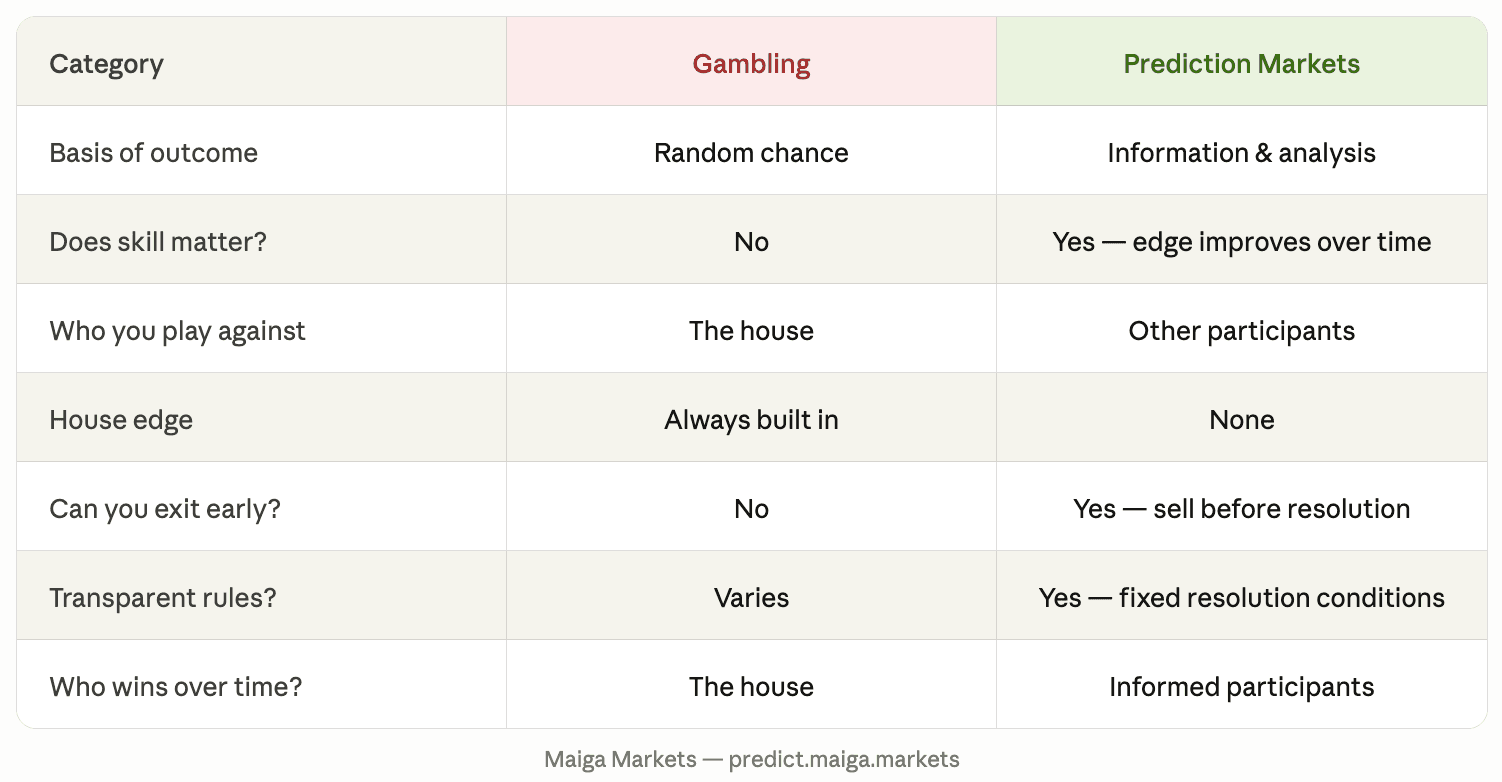
The odds reflect real information. Prices on a prediction market are set by thousands of participants, each bringing their own knowledge and analysis. When something newsworthy happens, the odds shift immediately. This isn't random. It's the market processing information in real time.
Skill compounds over time. In gambling, a beginner and an expert have the same odds. In prediction markets, traders who consistently make better-informed calls outperform over time. Your edge is real and improvable.
The rules are transparent and fixed. Every market has a published resolution condition – a specific outcome, a specific data source, a specific time. You know exactly what you're trading on before you put in a single dollar. No hidden mechanics, no house edge baked into the system.
You're trading against other participants, not the house. Prediction markets aggregate collective intelligence. You win when your read on a situation is better than the crowd's. That's fundamentally different from playing against a system designed to take your money.
In addition, in the prediction market, participants are able to sell their “shares” ahead of market resolution. Here is an example below:
In a prediction market, Adam can buy and sell his position anytime before resolution, meaning he is not locked into a fixed outcome like in gambling.
If his BTC view is wrong, he can exit early to cut losses (stop-loss); if correct, he can take profit early, just like in trading.
This makes it information-driven trading (price discovery and differing beliefs) rather than gambling based on fixed probabilities and outcomes.
Where the Line Can Get Blurry
To be fair, not everyone who uses prediction markets approaches them with research and discipline. Some people do treat it like a coin flip, picking sides randomly without any real basis for their view.
And in those cases? It can start to feel a lot like gambling.
But that's a user behavior issue, not a structural one. A chess board isn't gambling just because someone plays randomly. The tool itself rewards skill and information. What you bring to it determines your experience.
The difference between gambling and prediction markets isn't just in the platform. It's in how you use it.
The Bigger Picture: Who Actually Uses Prediction Markets
It's worth knowing that prediction markets aren't just for individual traders. Researchers, academics, and institutions have used them for decades as forecasting tools, specifically because they've been shown to aggregate information more accurately than traditional surveys or polls.
When real money is on the line, people tend to be more honest about what they actually believe. That's the underlying principle, and it's why prediction markets have been studied seriously in economics and policy research for years.
That's not the profile of a gambling product. That's a financial information tool.
How Maiga Markets Is Built Around This
On Maiga Markets, every element is designed to reinforce informed trading over guessing.
Before you confirm any trade, you see the current odds (what the market collectively believes the probability is). You see your exact payout. You see the resolution condition (the specific rule that determines the outcome). Nothing is hidden, nothing is random.
The CPMM model means your trade executes instantly at a transparent price. No order book manipulation, no hidden spreads. Just clear, real-time pricing based on market activity.
The markets cover BTC, ETH, BNB, SOL, XRP price outcomes, and Fear & Greed Index, with more market types on the way. Every one of them resolves based on published data. Not opinion. Not discretion. Data.
That's not gambling. That's trading with defined rules.
The Bottom Line
Prediction markets and gambling share one surface similarity: you put money on an outcome. But underneath that, they're built on completely different logic.
Gambling is designed around pre-determined randomness. Prediction markets are designed around information asymmetry. In gambling, the house always wins. In prediction markets, informed participants win over time.
If you approach prediction markets the same way you'd approach a slot machine – randomly, emotionally, without any basis for your view – you'll probably get similar results.
But if you come in with a view, back it with reasoning, and manage your positions with discipline? You're not gambling. You're trading.
Now is the best time to find out for yourself. Maiga Markets testnet is live, free credits are waiting, and the campaign is still ongoing. No real money needed to get started.
👉 See for yourself at predict.maiga.markets
This content is educational and not financial advice.